Perennial of the Calceolariaceae family, native to southern Chile and Argentina, where it colonizes high-altitude wet meadows, stream banks, and grassy slopes, generally between 1,000 and 2,500 meters.
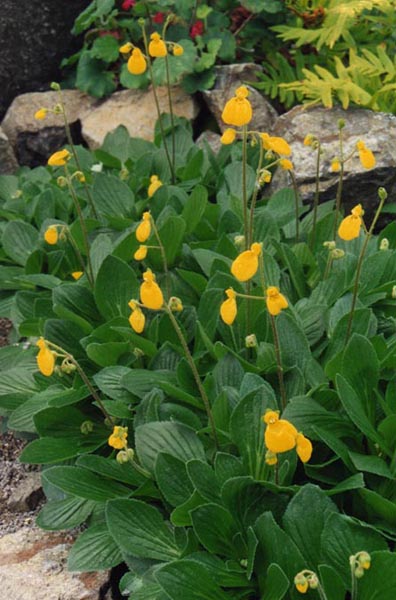
It forms large, low, dense clumps, hardly exceeding 15 to 25 cm in height. The foliage is particularly remarkable: large oval to elliptical leaves, dark green and shiny, very crinkled and strongly veined, arranged in tight rosettes that vigorously cover the ground. The slightly rough texture and sheen of the foliage are among the most immediately recognizable characteristics of the species.
The flowers, borne on slender upright stems rising above the foliage, are bilabiate and a bright, clear golden yellow. The lower lip, swollen into a round, plump pouch, clearly dominates the upper lip, reduced to a small discreet hood. They are generally grouped in pairs to fours per stem, hence the species name.
In its natural habitat, its flowering extends from December to February (austral summer). In cultivation under temperate climates, it blooms from June to August.
More accommodating than other Andean calceolarias, it tolerates fresh to slightly moist soils and moderate partial shade. Its hardiness is estimated down to -15°C in well-drained soil. It is suitable for cool rock gardens, water feature borders, and collection gardens, where its dense foliage and golden pouch-like flowers form a highly visually coherent ensemble.