A perennial of the Apiaceae family, Bupleurum falcatum is widely spread across Central and Southern Europe, Central Asia, and the Near East. It colonizes dry lawns, edges of light woods, rocky slopes, and sunny screes, generally on well-drained calcareous substrates, from the plains up to about 1,800 meters in altitude.
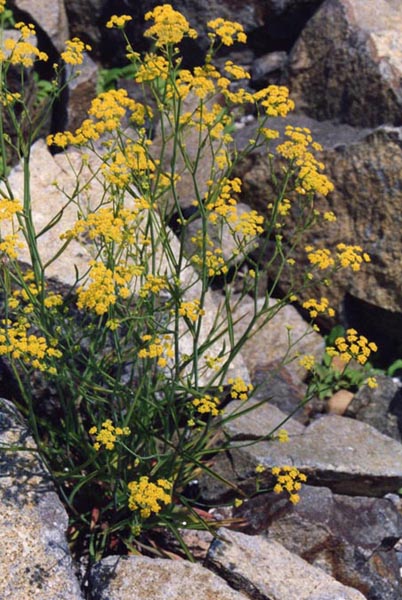
It develops an upright and airy clump, reaching 40 to 80 cm in height, with slender stems, highly branched in their upper part, giving the whole a light and almost ethereal appearance as confirmed by the photograph. The leaves are narrow, lanceolate to sickle-shaped — as suggested by the specific epithet —, a shiny dark green, sessile and slightly clasping the stem.
The flowers, tiny, are gathered in numerous and tight compound umbels, of a bright and clear yellow, which literally cover the top of the branched stems in a very visible golden cloud in the rocky landscape.
In its natural habitat, its flowering extends from July to September. In cultivation, it generally occurs from June to August.
It thrives in well-drained soil, poor to moderately fertile, in full sun exposure, and easily withstands summer drought once established. Its airy silhouette and bright yellow make it a plant of choice to enliven rock gardens and gravel gardens with a natural and spontaneous movement.