syn. Polygonum affine - Persicaria affinis
syn. Polygonum affine - Persicaria affinis
Perennial of the Polygonaceae family, Bistorta affinis — long known under the name Polygonum affine — is native to the Himalayas, from northern India to Nepal and Bhutan, where it carpets grassy slopes, rocky edges, and high-altitude meadows between 3,000 and 5,000 meters. It often forms vast colonies covering sun-exposed slopes, on well-drained but never dried-out soils.
It forms a creeping and dense carpet, rarely beyond 20 to 25 cm in height when in bloom, spreading widely by its stolons and superficial rhizomes. The leaves are lanceolate, from medium to dark shiny green, with marked veins; their underside is slightly paler. One of the most remarkable features of this species is the autumn coloration of the foliage, which gradually turns to brick red, bronze, and coppery russet before partially disappearing in winter.
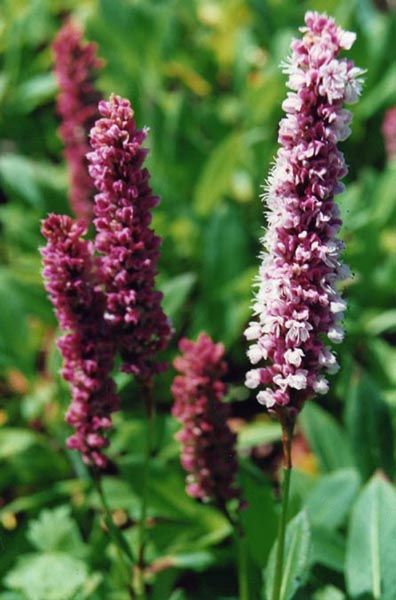
The flowers, tiny and gathered in erect and dense cylindrical spikes, are bright pink to pink-red, sometimes fading to creamy pink at the base of the spike. They persist very long on the plant, succeeding from the top to the base of the spike.
In its natural habitat, its flowering extends from July to September. In cultivation, it generally occurs from June to October, with a remarkable decorative longevity.
It thrives in fresh to moist, well-drained soil, in full sun or light partial shade. Excellent ground cover for moist rock gardens, banks, and slopes, it is fully hardy and requires very limited maintenance.