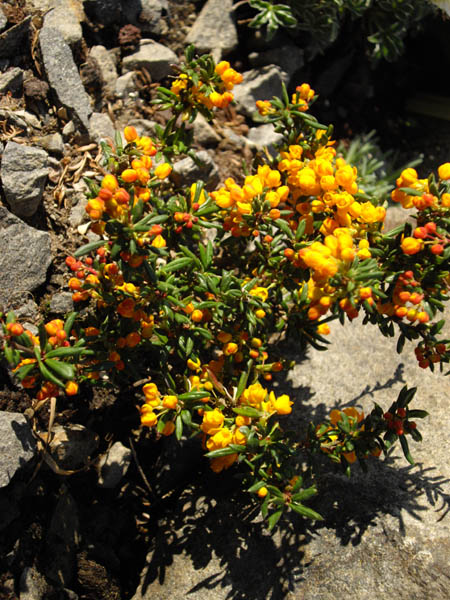
Dwarf shrub of the Berberidaceae family, this cultivar is a selected form of the hybrid Berberis x stenophylla, itself resulting from the cross between Berberis darwinii and Berberis empetrifolia, two species native to Chile and Argentina. The hybrid was obtained in Great Britain in the mid-19th century and gave rise to many cultivars, including this compact one particularly appreciated by rock garden plant collectors.
'Corallina Compacta' forms a dense, rounded, and slowly spreading bush, rarely exceeding 30 to 40 cm in height. The arching branches, finely spiny, bear small narrow leaves, linear to lanceolate, evergreen, dark glossy green on the upper side and glaucous underneath, giving the whole a fine and elegant texture.
The flowering is the most spectacular moment of its cycle: tiny flowers of a bright coral orange with coppery reflections, slightly pendulous, unfold in April-May along the arching branches, creating an effect of colorful embroidery on the dark cushion of foliage. The floral bud, of a more intense red, precedes the opening and prolongs the duration of the spectacle.
In its natural habitat, the parent species bloom in the southern spring. In cultivation under our latitudes, flowering occurs in April-May.
It thrives in well-drained soil, tolerates limestone and moderate drought. Its naturally compact habit makes it a choice subject for structured rock gardens, containers, and mineral compositions.