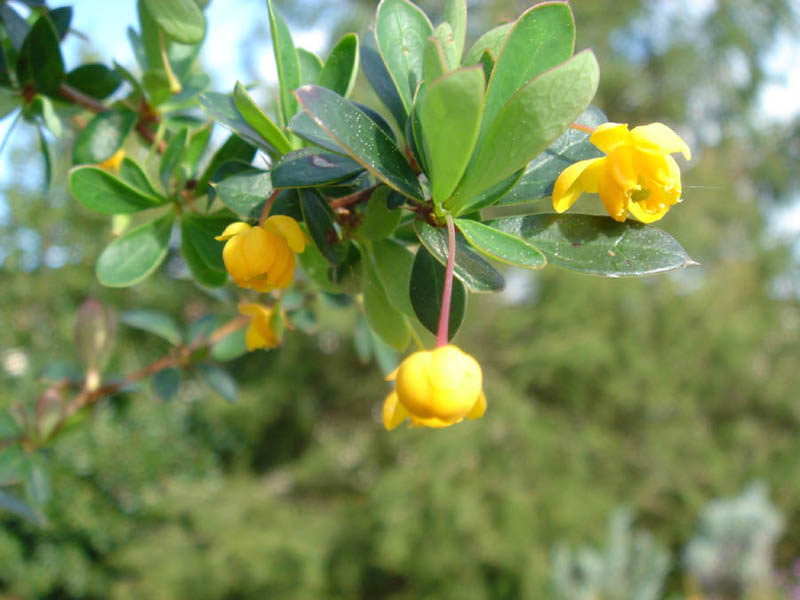
Dwarf shrub of the Berberidaceae family, this slow-growing cultivar is a selected form of Berberis buxifolia, a species native to southern Chile and Patagonian Argentina, where the typical form grows in open forests, shrubby heaths, and wind-swept rocky areas, from sea level to mid-altitudes.
The 'Nana' cultivar forms a dense, rounded, and compact bush, rarely exceeding 30 to 50 cm in height with a similar spread. The leaves are small, leathery, oval to elliptical, dark green and glossy, indeed reminiscent of boxwood, as suggested by its specific epithet. They persist in winter under mild climates, giving the shrub a neat appearance all year round.
The small, orange-yellow flowers appear in spring nestled among the leaves. They are followed by globular, frosted blackish-purple berries, ornamental and edible, appreciated by birds.
In its natural habitat, the flowering of the typical species extends from September to November in the southern hemisphere. In cultivation under our latitudes, it occurs in April-May.
This cultivar is distinguished by its exceptionally slow growth and its ability to form a perfectly regular cushion without pruning. It tolerates limestone, moderate drought, and windy exposures. Suitable for structured rock gardens and mineral compositions.