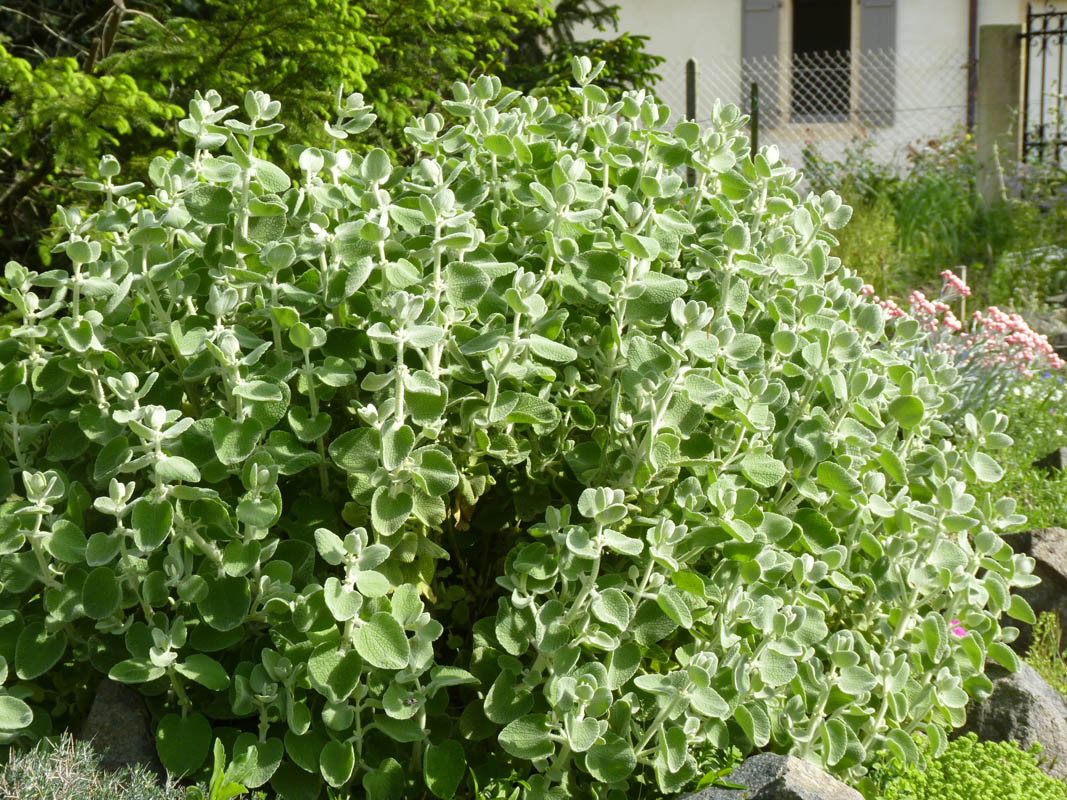
A subshrubby perennial of the Lamiaceae family, Ballota pseudodictamnus is native to the islands of the eastern Mediterranean, mainly Crete and the Aegean islands. It naturally grows on dry rocky slopes, open scrublands, and stony embankments exposed to the sun, in poor and well-drained soil conditions.
It forms a dense and rounded bush, highly branched, reaching 40 to 60 cm in height and often as much in width. The foliage is its most immediate asset: the leaves are oval, soft to the touch, entirely covered with a white silvery woolly tomentum that gives them an almost unreal appearance in full light. The stems themselves are whitish and woolly.
The flowers, small, pale pink to whitish, are inserted into funnel-shaped calyces with spreading teeth, persisting long after flowering and contributing as much as the leaves to the decorative effect of the plant. In its natural habitat, flowering extends from May to July.
In cultivation, it requires a perfectly drained, poor soil, in full sun, and tolerates summer drought well. It is more afraid of excess winter moisture than cold, and ultimately proves to be quite hardy. The persistent calyces and silver foliage ensure a visual interest that far exceeds the flowering period alone.