syn. Alyssum saxatilis
syn. Alyssum saxatilis
A perennial from the Brassicaceae family, Aurinia saxatilis is native to Central and Southern Europe, the Balkans, and Asia Minor, where it colonizes limestone cliffs, rocky screes, and sunny old walls, from dry hillsides to altitudes sometimes exceeding 1,500 meters.
It forms a semi-woody bushy cushion at the base, 20 to 30 cm in height with a comparable width, with a slightly cascading habit that allows it to naturally thrive over rocks and walls. The leaves are elongated, spatulate, with a characteristic gray-green due to a fine tomentose coating that makes them soft to the touch and gives them a very recognizable ashen texture.
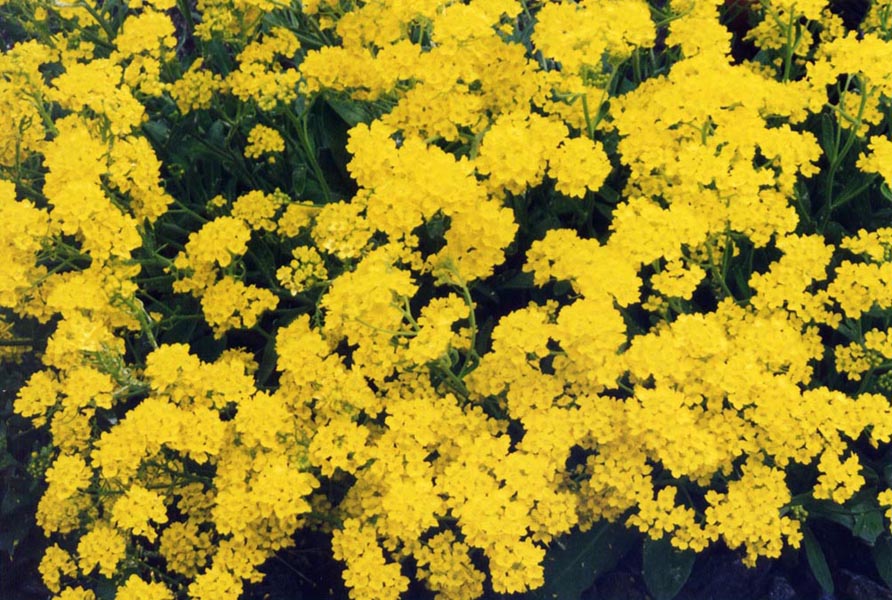
The flowers, tiny and with four petals, are grouped in dense and exuberant corymbs of a bright and luminous golden yellow, almost entirely covering the foliage at the time of flowering. In its natural habitat, its flowering extends from April to June depending on altitude. In cultivation, it generally occurs from March to May.
It withstands difficult conditions: poor, calcareous, very well-drained soil, in full sun. A light pruning after flowering helps maintain a compact habit. A classic companion of aubrietas in spring rock gardens, it was formerly used in popular herbal medicine for its supposed diuretic properties.