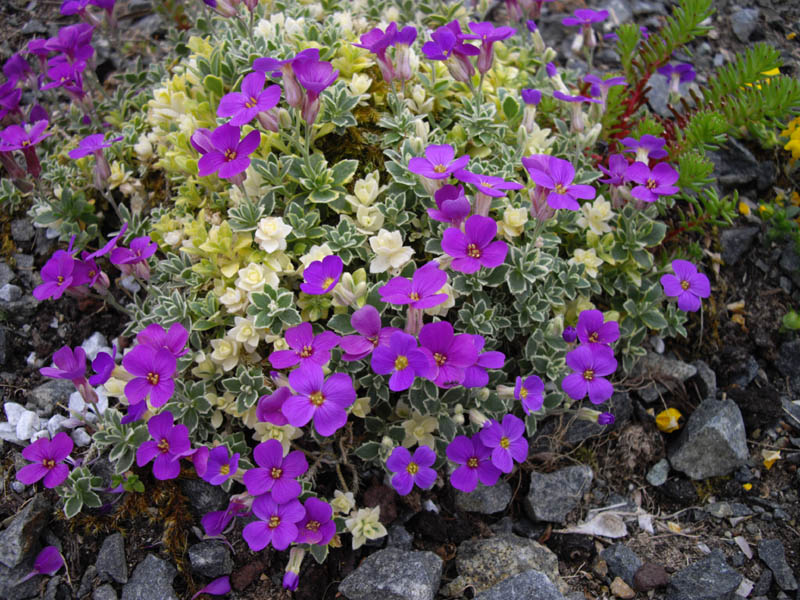
A cultivar from the Brassicaceae family, Aubrieta 'Downer's Variegata' is a variegated horticultural form, selected from species of the genus Aubrieta originating from the mountains of the eastern Mediterranean basin. A semi-evergreen perennial, it forms spreading cushions 8 to 12 cm in height, whose appearance is remarkable in all seasons.
The foliage consists of small spatulate leaves, slightly toothed and covered with a fine indumentum, broadly edged with cream to ivory white. The variegation is very pronounced here: some rosettes are almost entirely devoid of chlorophyll and appear pure white to yellowish, giving them a luminous effect but depriving them of any photosynthetic capacity. This feature, visually appealing, can weaken the plant in the long term, especially in difficult growing conditions.
The flowers are an intense violet to bright mauve, with four petals, borne in short, numerous clusters that contrast strongly with the light foliage. On the most discolored rosettes, the flowers themselves may appear faded.
In its natural habitat, the parent species bloom from April to June. In cultivation, flowering generally occurs from March to May.
This cultivar requires a full sun location, in well-drained, slightly calcareous soil. A light pruning after flowering and careful monitoring of the vigor of the most discolored rosettes help maintain the plant in good condition.