syn. Silene armeria
syn. Silene armeria
An annual from the Caryophyllaceae family, Atocion armeria is a species from central and southern Europe, found from the Iberian Peninsula to the Balkans and Asia Minor. It colonizes dry slopes, rock gardens, old walls, roadsides, and sunny wastelands, generally in plains or low mountains, on poor and well-drained substrates.
It forms an erect, slender but robust stem, 20 to 50 cm tall, bearing oval-lanceolate, glaucous, slightly fleshy leaves, sessile and clasping the stem in pairs. A characteristic and easily observable detail: the upper internodes of the stem are sticky and gluey, sometimes trapping small insects, which gives it the English nickname of catchfly.
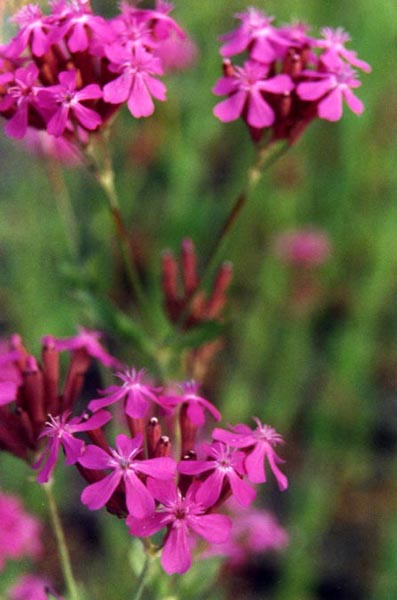
The flowers are small, bright pink to carmine, with five slightly notched petals, grouped in dense and compact corymbs at the top of the stems, forming very clear colored bouquets.
In its natural habitat, its flowering extends from May to August. In cultivation, it occurs from June to August depending on the sowing.
Easy to grow, it is sown directly in place in spring or autumn, in full sun, in any well-drained soil, even poor and stony. It reseeds itself spontaneously from year to year and naturally integrates into flowering rock gardens and natural-style gardens.