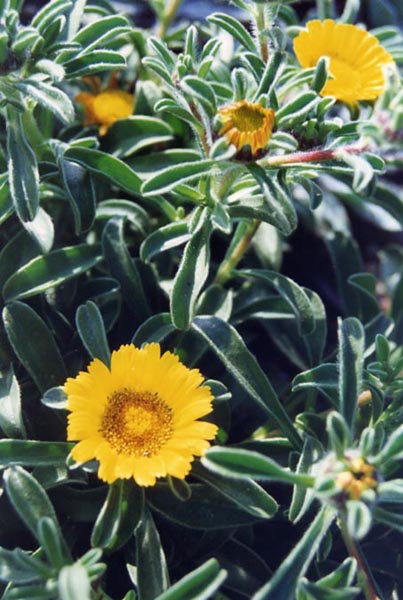
syn. Astericus maritimus
syn. Astericus maritimus
Perennial of the Asteraceae family, Astericus maritimus is a species from the Mediterranean basin, present from the Canary Islands and Madeira to the Iberian, North African coasts and the Middle East. It naturally grows on coastal cliffs, maritime rocks, and dry sandy terrains, at low altitude, often in direct contact with sea spray.
It forms a dense and spreading cushion, low, rarely exceeding 20 cm in height, with woody stems at the base and persistent, oblong foliage, of a grayish-green, covered with a fine whitish down that gives it a characteristic velvety texture to the touch. On long-established specimens, the habit tends to become distinctly prostrate and covering, forming large golden mats close to the ground.
The flowers are large solitary capitula, of a bright and luminous golden yellow, borne above the foliage on short stems. The bracts surrounding the capitulum are remarkably long and leafy, which immediately distinguishes the species from ordinary asters.
In its natural habitat, its flowering extends from February to May. The species is sensitive to frost. It requires full sun, a very well-drained, poor and dry soil. In climates with harsh winters, pot cultivation in a very mineral substrate, brought indoors in an unheated cold shelter in winter, is the safest solution to preserve it.