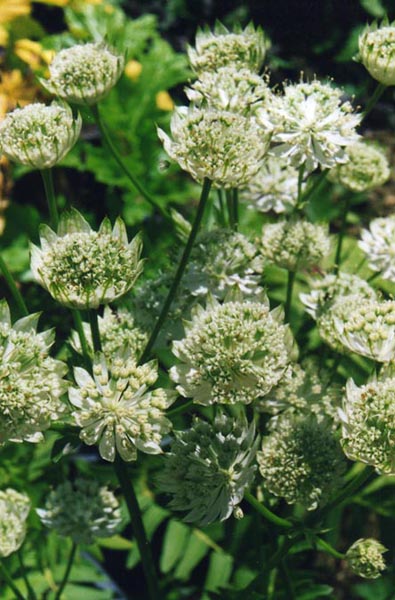
Perennial of the Apiaceae family, Astrantia major is a species from Central and Southern Europe, found from the Pyrenees and the Alps to the Carpathians and the Balkans. It occupies cool and bright undergrowth, high-altitude megaphorbia, moist mountain meadows, and shaded banks, generally between 800 and 2,000 meters.
It forms upright clumps of 50 to 80 cm, with deeply lobed palmate foliage, a bright green, long petiolate and very ornamental even when not in bloom. The stems are branched and slightly translucent against the light.
The flowers are gathered in compound umbels, each surrounded by a collar of lanceolate bracts, greenish-white veined with pink to carmine-pink depending on the individual. This flower-bract ensemble, of remarkable precision and delicacy, evokes a small botanical embroidery and constitutes the most immediately recognizable feature of the species.
In its natural habitat, its flowering extends from June to August. In cultivation, it occurs from June to September, often with a resurgence in autumn if the plant is cut back after the first flowering.
It prefers a cool, well-drained but never dry soil, rich in humus, in partial shade or light shade. It self-seeds spontaneously and can naturally colonize garden undergrowth, cool borders, and mountain-themed compositions.