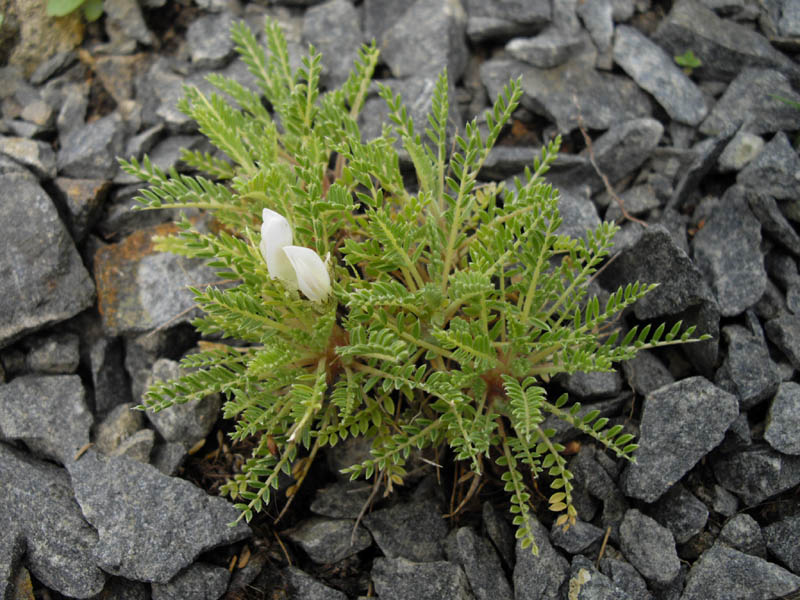
Perennial of the Fabaceae family, Astragalus angustifolius is a species from the eastern Mediterranean regions, found from Greece and Turkey to the Caucasus and the Middle East. It occupies dry rocky grasslands, limestone screes, and arid slopes, often between 800 and 2,000 meters in altitude.
It forms a thorny, hemispherical cushion, very dense and slowly growing, whose persistent branches gradually become woody at the base, giving the plant an almost mineral appearance with age. The leaves are finely pinnate, with narrow and silvery leaflets, and the stipules transform into rigid spines after the limb falls, a characteristic that gives the plant its very particular defensive appearance.
The flowers are small, papilionaceous, cream white to slightly pinkish, nestled at the base of the cushion and almost buried in the foliage during flowering.
In its natural habitat, its flowering extends from April to June depending on the altitude.
In cultivation, it requires intense full sun, a very well-drained, stony and poor soil, preferably limestone. It cannot tolerate stagnant moisture or heavy soils. Its slow growth and sculpturally architectured habit make it a plant of choice for characterful rockeries and gardens with a steppe or Anatolian inspiration.