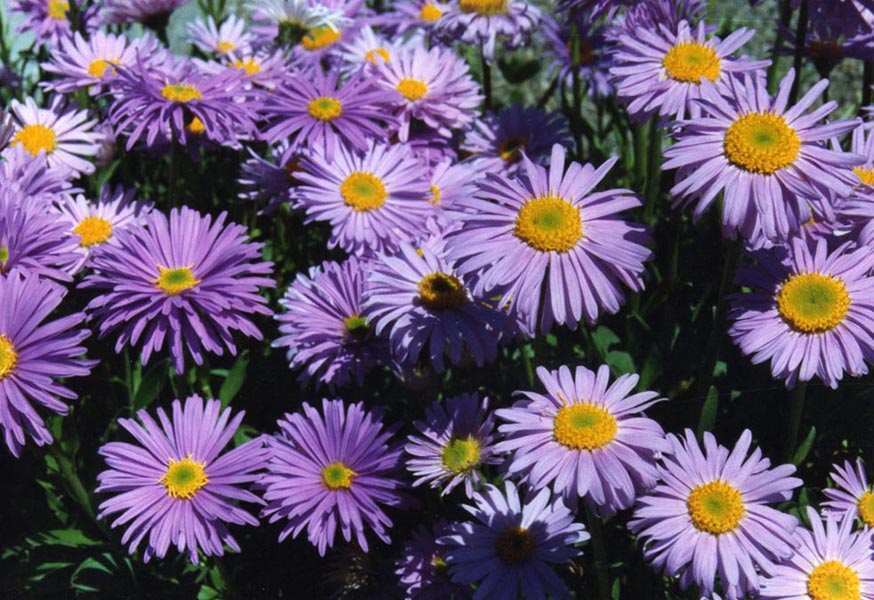
Perennial of the Asteraceae family, the alpine aster is a species of the mountainous regions of Europe and Central Asia, present in the Alps, the Pyrenees, the Carpathians, the Caucasus, and as far as Central Asia. It occupies rocky grasslands, stabilized scree, sunny limestone slopes, and windy ridges, generally between 1,500 and 3,000 meters in altitude.
It forms small low and spreading clumps, 10 to 25 cm in height, with sparsely branched stems each bearing a single large terminal capitulum relative to the plant's habit. The basal leaves are spatulate, grayish-green, slightly hairy; the cauline leaves are sessile and narrower. The ligules, numerous and narrow, are a bright violet to lilac, sometimes pinkish or more rarely white, and surround a bright yellow central disc that immediately catches the eye.
In its natural habitat, its flowering extends from June to August depending on the altitude. In cultivation, it generally blooms from May to July, with sometimes a slight resurgence in autumn.
Highly cultivated since the nineteenth century, it has given rise to many cultivars with varied colors, from pure white to deep violet. It requires well-drained soil, poor to moderately rich, preferably calcareous, and full sun exposure. Hardy and undemanding once established, it withstands summer drought and is perfectly suited to sunny rock gardens and gravel gardens.