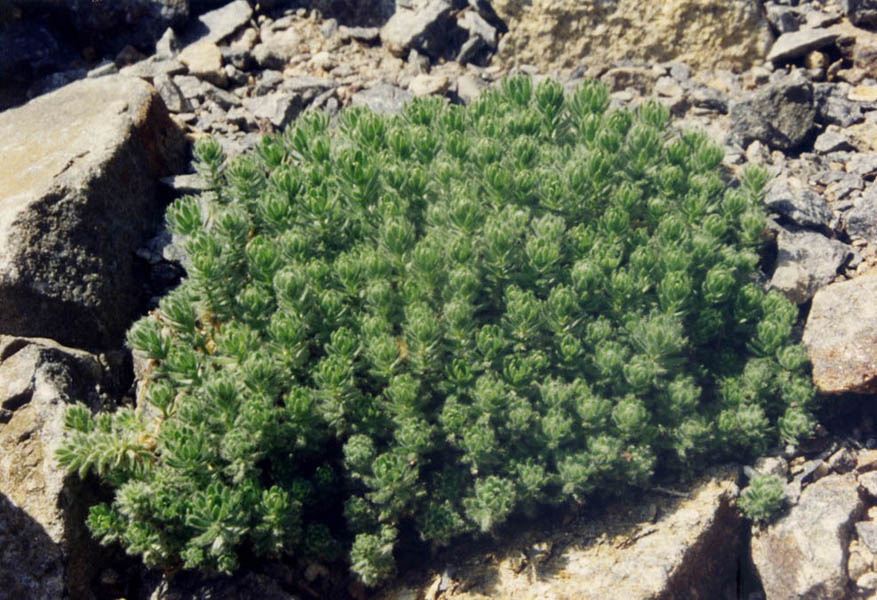
Perennial of the Rubiaceae family, Asperula hirta is endemic to the Pyrenees, where it occupies crevices in limestone rocks, cliffs, and sun-exposed lapiaz, between approximately 1,000 and 2,500 meters. Its ability to insinuate itself deeply into the smallest rock crevices, as shown in a photograph, is one of its most remarkable and characteristic adaptations.
It forms a fairly loose hemispherical cushion, 10 to 25 cm in height, with semi-woody stems at the base, erect and branched, bearing narrow linear leaves, mucronate and slightly ciliated, of a bright and shiny green, arranged in regular whorls. The epithet hirta, meaning hairy or bristly, refers to the fine hairiness that borders the leaves.
The flowers, tubular with four widely spread lobes, are pure white to very slightly pink, more pink in bud, grouped in terminal glomerules generously distributed over the entire plant to the point of almost entirely masking the foliage. In its natural habitat, its flowering extends from June to August depending on altitude. In cultivation, it occurs from May-June.
It requires a limestone substrate, very well-drained, a fully sunny exposure and perfectly tolerates summer drought. Planted in a wall crevice or limestone rockery, it fully reveals its natural character and vigor, true to its original Pyrenean habitat.