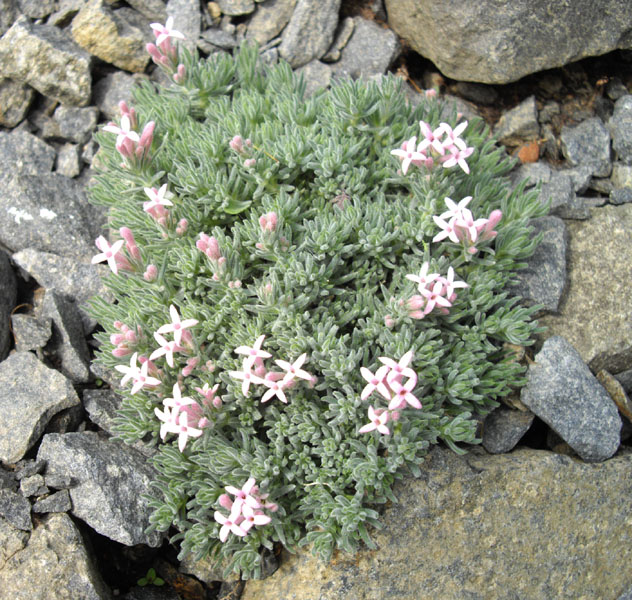
Perennial of the Rubiaceae family, Asperula daphneola is endemic to the mountains of the Middle East, mainly Turkey, Iran, and adjacent regions, where it colonizes rocky screes, crevices, and exposed stony slopes at altitude, generally between 2,000 and 3,500 meters. It belongs to the group of cushion asperulas, highly prized by alpine plant enthusiasts.
It forms a dense and compact hemispherical cushion, 5 to 15 cm in height, with woody stems at the base, covered with narrow, short, ciliated linear leaves, of a grayish to slightly glaucous green, arranged in tight whorls that give the plant a texture vaguely reminiscent of a dwarf daphne, hence its specific epithet.
The flowers, relatively large for the genus, are tubular with four spreading lobes, a soft pink fading to white at the center, borne in small terminal clusters that regularly emerge from the entire surface of the cushion. In its natural habitat, its flowering extends from June to August depending on altitude.
In cultivation, it requires perfect drainage, a poor mineral substrate, and full sun exposure. It is often grown in pots or alpine troughs to better control winter humidity, which is detrimental to it. A successful rock garden display is a well-deserved reward for the attentive grower.