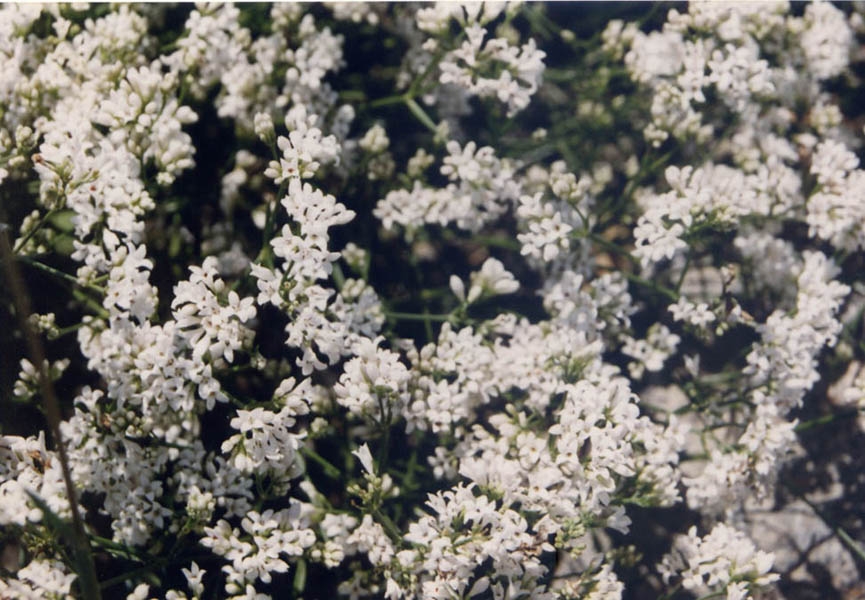
Perennial of the Rubiaceae family, Asperula cynanchica is widely spread in Europe, from the Iberian Peninsula to Central and Eastern Europe, as well as in North Africa. It occupies dry and calcareous grasslands, rocky slopes, low garrigues and open edges, from the plains to medium altitudes. In France, it is common on the causses, calcareous slopes and brome grasslands.
It forms loose and branched tufts, 15 to 40 cm in height, with slender stems, upright to slightly spreading, bearing very narrow linear leaves, arranged in whorls, of a fresh slightly glaucous green. The whole plant has an airy lightness that contrasts with the floral density at the time of full bloom.
The flowers, tiny and tubular with four lobes, are gathered in very dense terminal cymes, of pure white or slightly pinkish in bud, covering the plant with a characteristic airy cloud. In its natural habitat, its flowering extends from June to August. In cultivation, it generally begins in May-June. The plant was formerly used in folk medicine as a diuretic and against certain kidney ailments, hence its epithet cynanchica.
Easy and robust, it adapts to any well-drained soil, preferably calcareous and poor, in full exposure. It perfectly tolerates summer drought and is easily suited to a sunny rock garden or naturalization on a calcareous embankment.