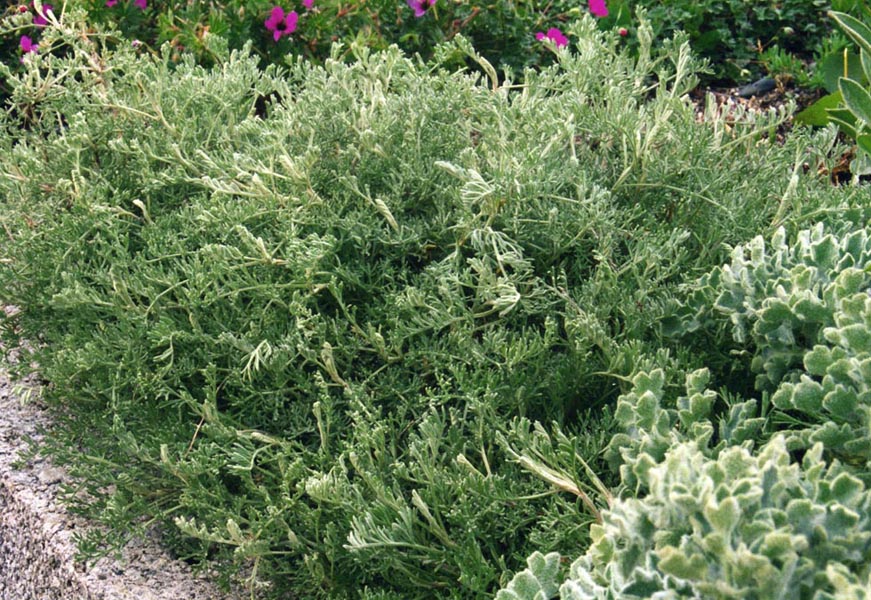
Perennial of the Asteraceae family, Artemisia maritima is native to the coasts and salty inland areas of Western and Northern Europe, from the shores of the English Channel and the North Sea to the salty steppes of Central Asia. It colonizes salt meadows, mudflats, estuary banks, and saline grounds, always in full exposure, at low altitude.
It forms a compact and aromatic bush, 30 to 60 cm in height, with whitish stems branched from the base. The foliage, finely divided into narrow linear segments, is densely tomentose, with a characteristic silvery gray, and releases a strong camphor-like scent when crushed. This powerful scent is one of the most immediately recognizable traits of the species.
The capitula, small and yellowish, are arranged in erect and leafy panicles. In its natural habitat, its flowering extends from August to October. The species was once used in traditional medicine, notably as an anthelmintic, under the name semen-contra.
In cultivation, it requires well-drained, light soil, tolerant or even slightly saline, in full exposure. Hardy and undemanding, it withstands drought and is suitable for seaside gardens or rockeries in a maritime environment.