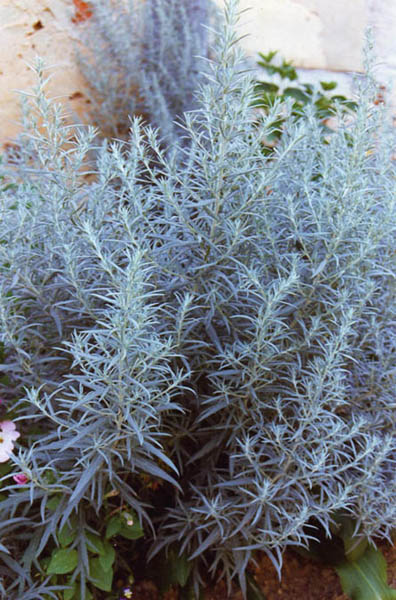
Perennial of the Asteraceae family, Artemisia ludoviciana is native to North America, where it extends from the great central plains to the semi-arid regions of the western continent. The albula variety, the most silvery of the group, naturally grows in dry prairies, open grounds, and well-exposed rocky slopes, on poor and well-drained substrates.
It forms upright and colonizing clumps, reaching 60 to 90 cm in height, developing through stolons and gradually covering large areas. Its main attraction lies in its foliage: the leaves, lanceolate to slightly lobed, are covered with a dense tomentum that gives them an intense and persistent silvery white throughout the season, one of the purest whites one can achieve in a full sun garden.
The capitula, discreet and yellowish, are gathered in narrow panicles. In its natural habitat, its flowering extends from July to September. In cultivation, the flowering often takes a back seat as the silvery foliage dominates the visual effect.
It requires a well-drained soil, poor to moderately fertile, in full exposure. It tolerates drought once established, but its stoloniferous vigor requires monitoring in confined spaces.