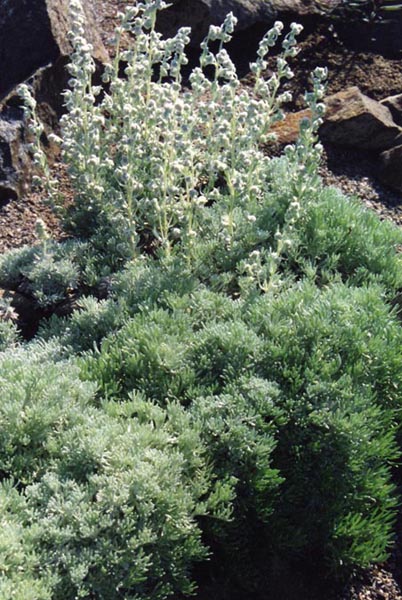
Perennial of the Asteraceae family, Artemisia alpina is a circumpolar species of high latitudes and mountain ranges of Eurasia, found in the Alps, the Urals, Siberia, and Arctic regions. It occupies screes, open rock gardens, wind-swept ridges, and short alpine grasslands on poor, well-drained substrates, generally between 2,000 and 3,500 meters.
It forms small compact clumps, semi-woody at the base, rarely exceeding 15 to 25 cm in height outside of flowering. The foliage, finely cut into narrow segments, is densely covered with a silky white-silver tomentum that gives it an almost metallic sheen, remarkable even outside of any flowering. The flowering stems rise in small slender spikes bearing numerous globular capitula, whitish to slightly yellowish, also densely cottony.
In its natural habitat, its flowering extends from July to September. In cultivation, it generally blooms in August.
It requires a very well-drained, poor soil, in full sun exposure; it dreads excess winter moisture. Its cold resistance and silvery foliage persisting throughout the season make it a choice subject for mineral rock gardens with cool tones.