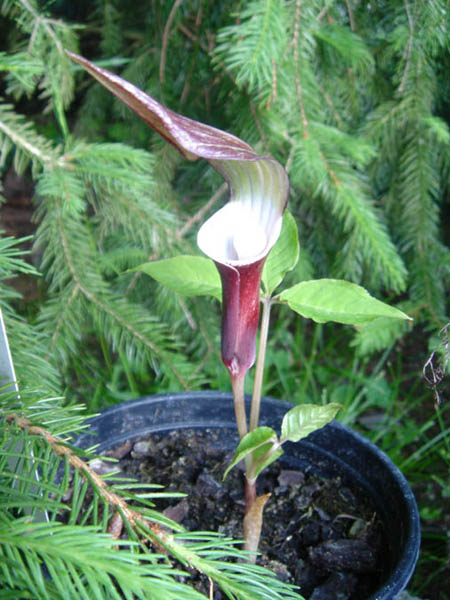
Tuberous perennial of the Araceae family, Arisaema sikokianum is native to Japan, where it is mainly found on the islands of Shikoku and Honshu. It grows in moist and shaded deciduous undergrowth, on humus-rich soils, cool to moderately moist, well-drained, generally between 500 and 1,500 meters in altitude.
It produces one or two compound, palmate leaves, with three or five deep green oval leaflets, sometimes slightly marbled with silver, borne on sturdy petioles that can reach 40 to 60 cm in height. The inflorescence, characteristic of the genus, is an upright spathe, dark purple-brown with whitish stripes on the outside, opening to reveal a velvety, luminous immaculate white interior, which envelops a remarkably swollen spadix at the top, pure white and club-shaped. This striking contrast between the dark exterior and the bright interior is the most distinctive and immediately striking feature of the species, which is among the most prized arisaemas by collectors.
In its natural habitat, flowering extends from April to June. In cultivation, it generally occurs in April-May.
It requires deep, humus-rich, cool, well-drained soil, in shade or partial shade, protected from late frosts that can damage young shoots. The tuber must be planted quite deeply to protect it from the cold. It is suitable for woodland gardens and shaded compositions with a natural and forest character.