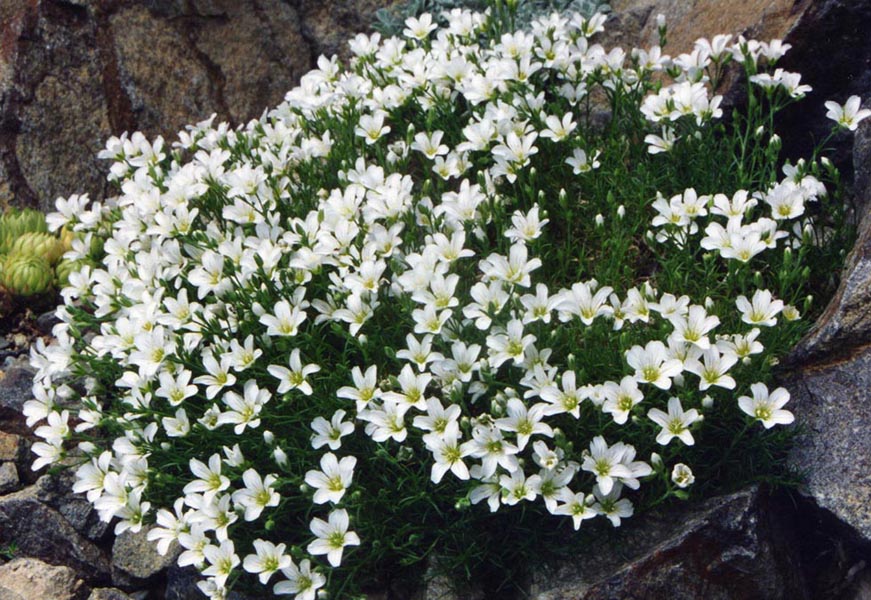
Perennial of the Caryophyllaceae family, Arenaria tmolea is an endemic species of western Turkey, described from specimens collected on the Tmolus massif, now Bozdağ, in Lydia. It occupies rock gardens, rock fissures, and dry alpine lawns on calcareous or schistose substrates, between approximately 1,500 and 2,200 meters.
It forms small, compact, rounded cushions, 3 to 8 cm in height, composed of narrow, linear to subulate, rigid and spiky leaves, of a grayish-green, densely interwoven along the branches lignified at the base. This tight structure, adapted to the freezing, windy, and pronounced summer drought conditions of the Anatolian mountains, gives the plant an appearance entirely comparable to that of cushion sandworts of the Alps or the Pyrenees.
The flowers are white, with five petals, borne in small numbers at the end of the branches, producing a discreet but elegant effect on the cushion. In its natural habitat, flowering extends from May to July depending on altitude and exposure.
In cultivation, it requires full sun, very careful drainage, a poor to neutral or calcareous mineral substrate, and protection against stagnant winter moisture. It is suitable for troughs and specialized alpine rock gardens. Its Anatolian origin and relative rarity in collections make it a species appreciated by rock garden enthusiasts off the beaten path.