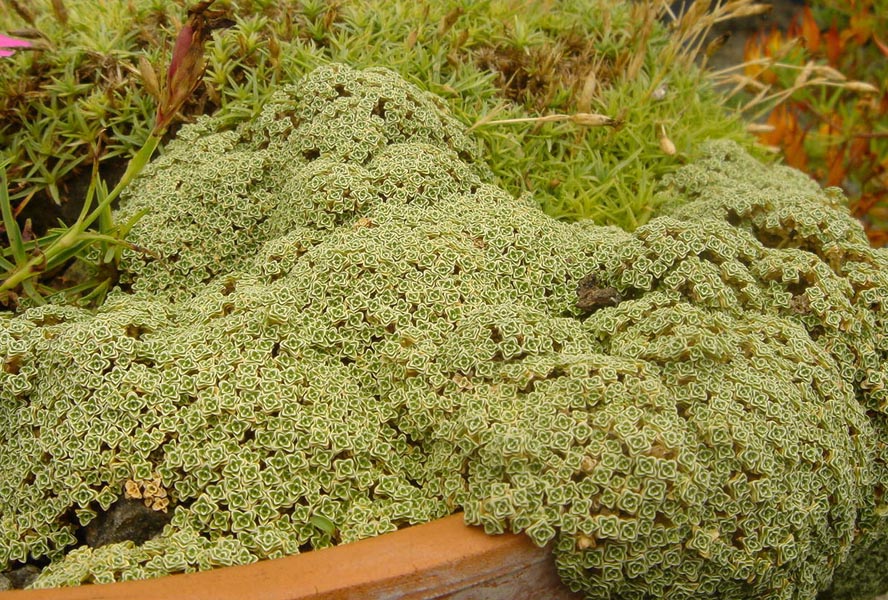
syn. Arenaria tetraquetra ssp granatensis
syn. Arenaria tetraquetra ssp granatensis
Perennial of the Caryophyllaceae family, this subspecies of Arenaria tetraquetra is endemic to the mountainous massifs of the southern Iberian Peninsula, mainly the Sierra Nevada and the Betic Sierras, where it represents the southern form of the group. It colonizes rock gardens, screes, and alpine meadows on siliceous or mixed substrates, generally between 2,000 and 3,000 meters.
Like the type subspecies, it forms dense and rigid cushions, 3 to 8 cm in height, with branches adorned with short, regularly arranged imbricated leaves. However, it differs by a slightly looser habit, somewhat wider and less strongly keeled leaves, and proportionally larger flowers, with well-developed white petals that are clearly more visible compared to the foliage. It is precisely this more generous and ornamental flowering that motivated the epithet amabilis.
In its natural environment, flowering extends from June to August depending on altitude and exposure. In cultivation, it generally occurs in May-June.
It requires the same conditions as the type subspecies: full sun, perfect drainage, poor mineral substrate, careful collar aeration. Its sensitivity to stagnant winter humidity makes it suitable for cultivation in a trough or well-constructed alpine rock garden. Its rarity in cultivation and endemic origin make it a sought-after plant for collectors specializing in Iberian alpine flora.