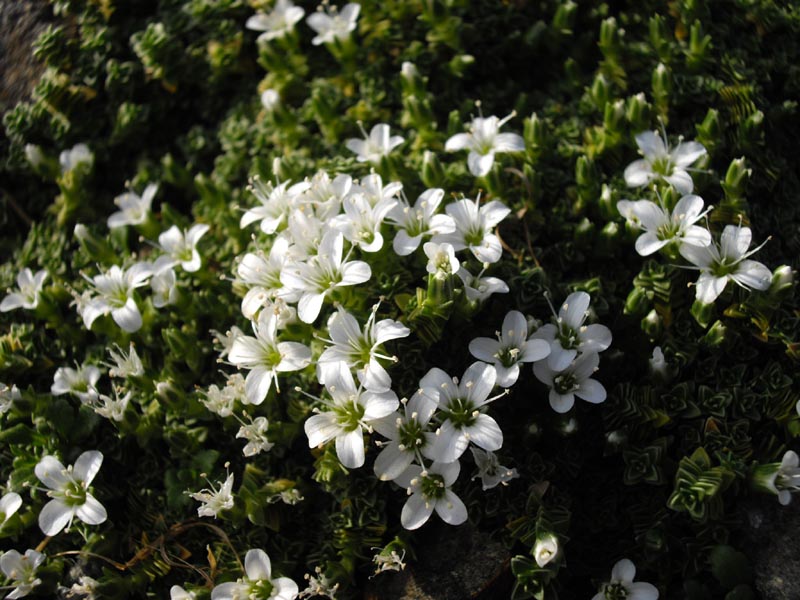
Perennial of the Caryophyllaceae family, Arenaria tetraquetra is a species of the high mountains of the Iberian Peninsula and southern France, mainly found in the Pyrenees, the Sierra Nevada, and the Cantabrian ranges. It occupies rock gardens, rock crevices, and alpine lawns on calcareous or siliceous substrates, generally between 1,800 and 3,000 meters.
It forms extremely dense and rigid cushions, 3 to 10 cm in height, whose structure is immediately recognizable: the leaves, very short, oval, and keeled, interlock in four regular rows along the stems, giving each branch a geometric and braided, almost mineral aspect, more reminiscent of a succulent than a caryophyllaceous plant. It is this characteristic, visible in photographs outside of flowering, that earns it its epithet.
The flowers are white, with five petals, modest in size, borne at the ends of the branches and produced in sufficient numbers to sprinkle the cushion with bright stars without completely covering it. In its natural habitat, flowering extends from June to August depending on the altitude. In cultivation, it generally occurs in May-June.
It requires full sun, perfect drainage, a poor mineral substrate, calcareous or neutral, and excellent collar aeration. Very sensitive to stagnant humidity, it is ideally cultivated in a trough or well-exposed alpine rock garden, where the architectural precision of its foliage is a permanent attraction, far beyond the sole flowering period.