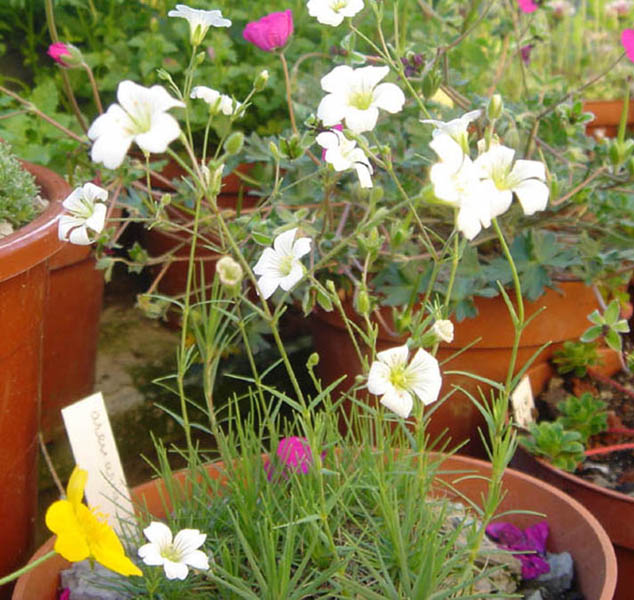
Perennial of the Caryophyllaceae family, Arenaria ledebouriana is native to Anatolia and the Caucasus, where it grows on rock gardens, screes and dry rocky slopes of mountain ranges, at altitudes between approximately 1,500 and 3,000 meters.
It forms a compact and tight cushion, of low height, composed of small linear to subulate leaves, rigid, grayish-green to glaucous, densely imbricated on woody stems at the base. This fine and tight foliage, slightly silvery depending on the light, gives the plant a mineral appearance very much in keeping with alpine character rock gardens.
The flowers are white, with five well-developed petals, borne individually or in small groups on short peduncles standing above the cushion. The sepals are distinctly veined and greenish, forming a contrasting calyx. In its natural habitat, flowering extends from June to August depending on altitude. In cultivation, it generally blooms in May-June.
It requires full sun exposure, a very well-drained, poor, stony or sandy soil, and tolerates summer drought well once established. Excess winter moisture is unfavorable to it. It is perfectly suited to alpine-style rock gardens, gravel gardens, and cultivation in pots or troughs.