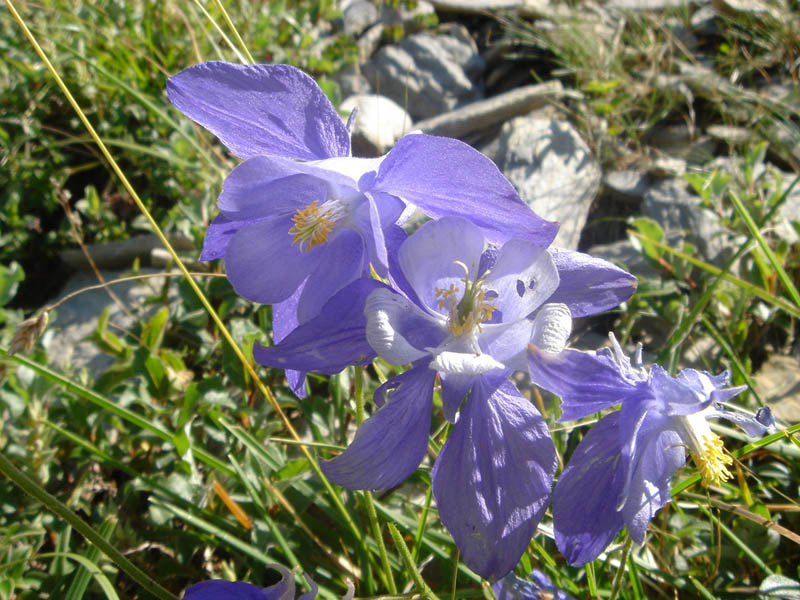
photographed in the Pyrenees
photographed in the Pyrenees
Aquilegia pyrenaica is an alpine columbine whose name clearly indicates the main geographical origin: the Pyrenees, a mountain range forming the natural border between France and Spain, to which it is largely endemic or subendemic, with some populations reported in the adjacent Cantabrian mountains of northern Iberian Peninsula. This species constitutes one of the many characteristic and emblematic floristic elements of the Pyrenean flora, rich in endemic taxa shaped by the complex geological and climatic history of this massif.
Morphologically, Aquilegia pyrenaica is a modest-sized plant with a dwarf to semi-dwarf habit, generally reaching 10 to 30 cm in height depending on altitude and local conditions, classifying it among the small-sized alpine columbines adapted to the harsh conditions of the subalpine and alpine levels. Its flowers are a bright blue to intense and luminous blue-violet, with straight or slightly curved spurs, a characteristic that brings it closer to alpine columbines pollinated by long-tongued bumblebees frequenting high-altitude grasslands. The sepals are spread out, matching the blue hue of the petals, and the whole flower exudes an impression of alpine freshness and purity that is particularly appealing.
Its natural habitat consists of alpine and subalpine grasslands, rocks and stabilized scree, snow hollows, and grassy slopes at altitude, generally between 1,500 and 2,800 meters above sea level, on calcareous or siliceous substrates depending on the populations and geographical areas. It thrives in cool, well-drained, and relatively poor soils, exposed to intense light while benefiting from prolonged protective winter snow cover, typical conditions of highly specialized alpine plants.
Taxonomically, Aquilegia pyrenaica is generally subdivided into several subspecies or varieties according to authors, reflecting the morphological variability observed between the different populations distributed across the entire Pyrenean massif and the Cantabrian reliefs. The most frequently recognized subspecies differ notably in plant size, intensity of floral coloration, and certain leaf characteristics, reflecting local differentiation linked to the isolation of populations in valleys and massifs separated by passes and low-altitude areas that are less favorable.
In horticulture, Aquilegia pyrenaica is a sought-after plant by alpine plant specialists and rock garden enthusiasts for its compactness, the vividness of its blue coloration, and its natural adaptation to the cold and well-drained conditions of mountain gardens. It is preferably cultivated in a carefully maintained alpine rock garden, in a pot with a very draining mineral substrate, or in a reconstructed alpine garden, sheltered from excess winter moisture, which is its main threat in cultivation under milder and wetter climates than its original habitat.