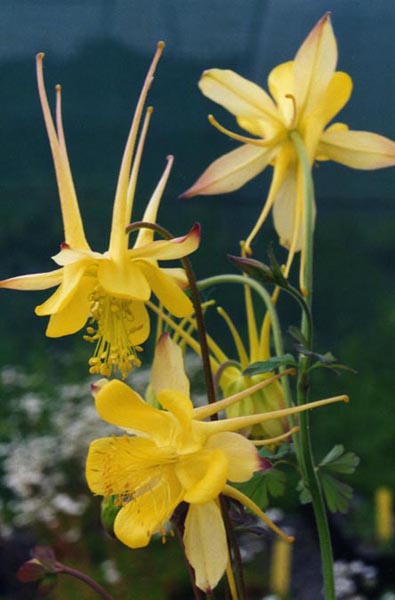
Aquilegia longissima is a spectacular columbine native to southwestern Texas and northern Mexico, particularly represented in the canyons and moist rocky areas of the Chisos Mountains and surrounding regions of the Chihuahuan Desert. Its specific epithet, from the Latin longissima meaning "the longest", directly and eloquently refers to its most remarkable and immediately striking feature: its extraordinarily long spurs, which are among the most developed in the entire Aquilegia genus and the entire Ranunculaceae family.
These spurs can reach lengths between 10 and 18 cm, sometimes more in the most vigorous populations, which is absolutely exceptional within the genus. Straight, slender, elegantly tapered towards their tip, they give the flower a spider-like silhouette and an almost unreal lightness, quite unique among columbines. The flowers themselves are a pale yellow to bright sulfur yellow, with spreading sepals and petals of the same hue, creating an entirely monochrome flower in golden and lemon tones that contrasts pleasantly with the finely cut glaucous-green foliage.
The plant reaches 60 to 90 cm in height, or even more in favorable conditions, with a slender and airy bearing, branched stems bearing several simultaneously hanging flowers with incomparable grace. Its natural habitat consists of shaded and cool areas along permanent or semi-permanent watercourses in otherwise arid landscapes, notably in canyons where the moisture and shade of the rocky walls create favorable microclimates within an otherwise desert environment.
Ecologically, the extraordinary length of the spurs of Aquilegia longissima is intimately linked to its exclusive pollination by hawkmoths with very long proboscises, notably Hyles lineata and other Sphingidae species capable of reaching the nectar at the bottom of these oversized appendages. This spectacular coevolution between the flower and its pollinator is a classic and frequently cited example of plant-insect coevolution, perfectly illustrating how the selection pressure exerted by pollinators can lead to the evolution of extreme floral morphologies.
In horticulture, Aquilegia longissima is appreciated by passionate gardeners for its exceptional character and late summer bloom, later than most other columbines, which pleasantly extends the season of interest of the genus in the garden. It has also been widely used in hybridization programs, passing on to its descendants the remarkable length of its spurs, which can be found in many modern long-spurred cultivars.