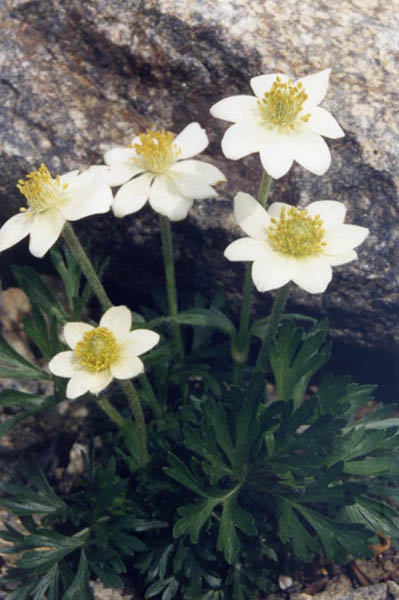
Small perennial anemone of high mountains, native to the Alps, the northern Apennines, and the Balkans, at altitudes of approximately 1,800 to 3,200 meters. Its name refers to Mount Baldo, a massif dominating Lake Garda in northern Italy, one of the sites where it was historically observed and described. Belongs to the Ranunculaceae family.
Small-sized plant, reaching 5 to 15 cm in height, with a short and robust rhizome. The basal leaves, long-petioled, are divided into ternate segments then finely divided, of medium green, slightly hairy. The cauline leaves, numbering three, form a characteristic collar under the flower, sessile and deeply cut in turn. The solitary flower raises 8 to 10 tepals — a high and characteristic number of the species — of pure white, sometimes slightly tinged with blue-violet or pink on their outer face, surrounding a center of yellow stamens and numerous carpels. Blooming from July to August depending on altitude.
It thrives in rocky lawns, stabilized screes, and snow hollows on limestone substrates, in full exposure. In cultivation, it requires perfect drainage, a limestone and stony substrate, and suffers from excess winter moisture. Delicate to maintain outside its natural habitat, it is uncommon in rock gardens.