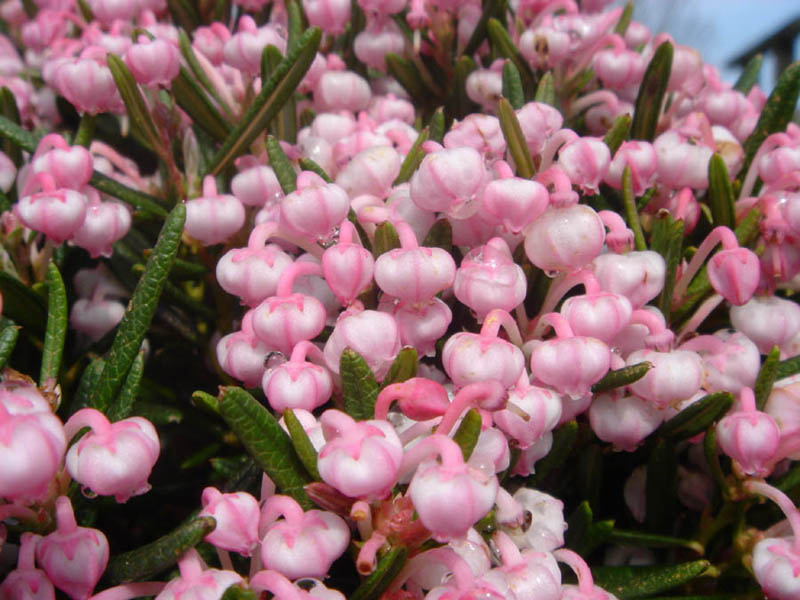
Dwarf and evergreen shrub of the Ericaceae family, whose type species is circumpolar, found in bogs and wet, acidic heaths of the northern hemisphere, from northern and central Europe through Siberia to Japan and North America. In Europe, it is naturally found in the sphagnum bogs of cold and mountainous regions, where it closely associates with Sphagnum , Calluna , Vaccinium oxycoccos and Eriophorum , in conditions of extreme acidity, permanent moisture, and remarkable mineral poverty.
The 'Compacta' cultivar forms a very dense and compact small shrub, not exceeding 20 to 30 centimeters in height for a similar spread, tighter and more regular than the type form which may have a slightly looser and creeping habit. The leaves are narrowly lanceolate, almost linear, leathery and evergreen, with a characteristic bluish-green on their upper side, white glaucous on the underside due to a protective waxy layer, the edges slightly rolled under in a classic arrangement of bog plants adapted to limit water loss through transpiration despite a moisture-saturated environment — an apparent paradox explained by the low availability of usable liquid water in the very cold and very acidic substrates of bogs.
The flowering, in April-June, is of exquisite delicacy: small urns or hanging bells, from soft pink to bright pink, grouped in short terminal clusters, present the characteristic urn-shaped corollas of the Ericaceae — swollen, closed at their end, opening only by a small orifice — which constitutes an adaptation to pollination by bumblebees capable of vibrating their wing muscles to extract pollen by sonication. These pink flowers against the blue-green foliage create a chromatic association of great finesse.
In cultivation, the requirements of Andromeda polifolia 'Compacta' are non-negotiable and directly modeled on the conditions of its natural habitat: soil must be acidic, peaty, constantly cool to moist, rich in undecomposed organic matter, poor in minerals. It absolutely cannot tolerate limestone, drought, or heavy poorly drained soils without constant moisture. It thrives in both full sun and light shade, provided the substrate moisture is ensured. It is perfectly hardy, easily withstanding the harshest winters.
Its use in the garden is naturally oriented towards bog gardens, the banks of water features on acidic substrate, or heather rockeries maintained in moist and acidic conditions. It harmoniously associates with other dwarf Ericaceae — Calluna , Erica tetralix , Vaccinium — as well as with cotton grasses, sundews, and bog primroses in particularly evocative reconstructions of bog ecosystems. Propagation is done by semi-hardwood cuttings in summer, or by natural layering favored by the plant's creeping habit.