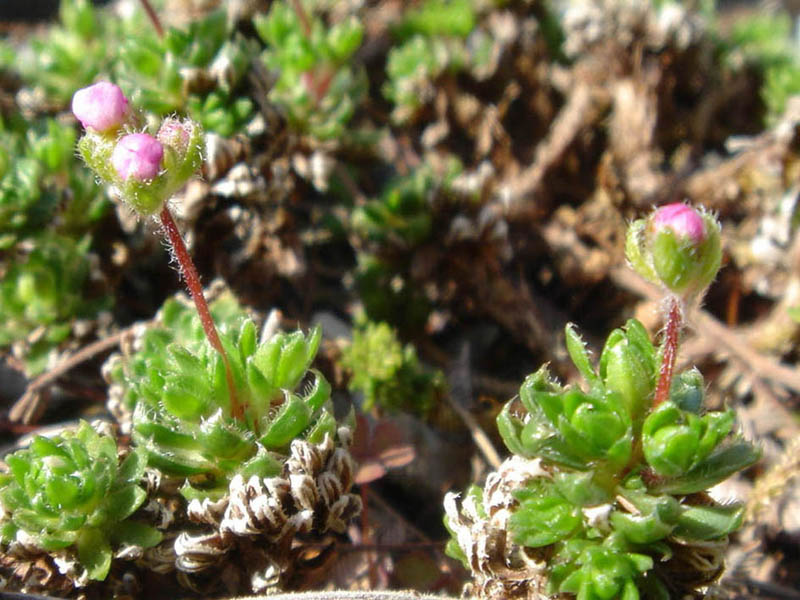
Dwarf perennial of the Primulaceae family, native to the Himalayas, from Kashmir to western Nepal, where it grows in alpine meadows and rock gardens between 3,000 and 4,500 meters in altitude. Its epithet mucronifolia refers to the mucro — a small rigid point ending the leaf blade — which characterizes its leaves and distinguishes it from related species with obtuse leaves.
It forms cushions or spreading tufts composed of rosettes with narrowly lanceolate leaves, ending in a characteristic small point, green to slightly glaucous, covered with fine hairs. The flowers are white to very pale pink, borne in small umbels on short stems, with the typical yellow eye of the genus, in June-July. The texture of the foliage and the shape of the rosettes give it a neat and precise appearance, different from species with more tomentose foliage.
In cultivation, it follows the general rules of Himalayan androsaces: excellent drainage, neutral to slightly acidic substrate, bright exposure, protection against excess winter moisture. It is mainly cultivated by specialists in Himalayan alpine plants and is featured in the collections of alpine societies, where it is appreciated for its distinctive characteristics and the cleanliness of its mucronate foliage. Propagation by seed or rosette cuttings.