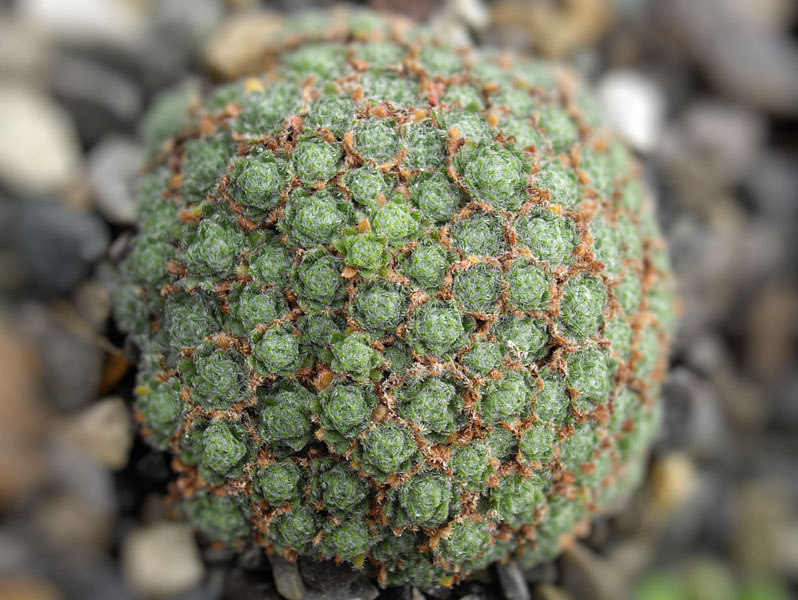
Swiss Androsace, or Androsace helvetica. Dwarf perennial of the Primulaceae family, one of the most emblematic and difficult to cultivate cushion androsaces, found in the Alps — mainly the central and eastern Alps, from the Bernese Alps to Austria — on limestone rocks, cliff crevices, and windy rocky ridges between 2,000 and 3,500 meters altitude. It is the archetype of alpine plants specialized in extreme habitats, perfectly adapted to conditions of intense cold, prolonged snow cover, high UV radiation, and abrupt alternations of freezing and thawing.
It forms cushions of extraordinary density and compactness, true hard cushions to the touch, the rosettes closely interlocked and contiguous composed of extremely short and rigid leaves, densely covered with short hairs forming a whitish felt so tight that it effectively protects the meristems from extreme temperatures and drying by the wind. This cushion can reach 20 to 30 centimeters in diameter on individuals several decades old, as growth is extremely slow — a few millimeters per year. The flowers are white, sessile or almost sessile, placed directly on the cushion, with a yellow eye, surprisingly large in size compared to the rosettes that bear them, creating during full bloom in June-July a spectacular white cushion effect.
In cultivation, it is reputed as one of the most difficult alpine plants to maintain sustainably. It requires absolute drainage, a very poor limestone substrate, rigorous protection against any stagnant winter moisture, and maximum ventilation. It is almost exclusively cultivated in pots in very mineral mixtures under perfectly ventilated cold shelter, or in specialized alpine greenhouses. Even in expert hands, it can wither for no apparent reason. Its extreme demand is compensated by the incomparable beauty of its flowering cushions, which are among the most beautiful spectacles that alpine cultivation can offer. It is regularly awarded in specialized exhibitions of the Alpine Garden Society and the Scottish Rock Garden Club.