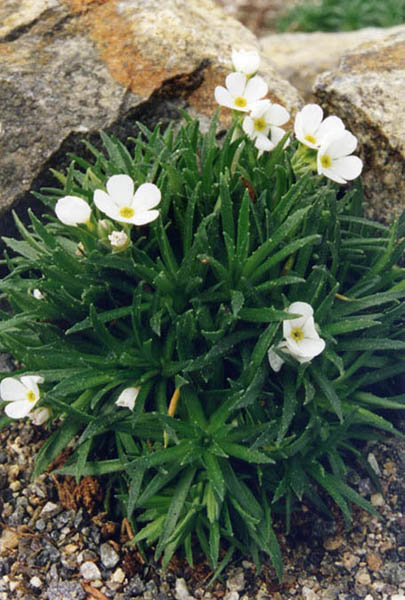
Dwarf perennial of the Primulaceae family, endemic variety of the Franco-Italian Alps, mainly concentrated in the Briançonnais massif, the Queyras, and the adjacent valleys of Piedmont, on alpine lawns, rock gardens, and granite screes between 1,800 and 3,000 meters in altitude. This endemic with a restricted range is distinguished from the typical variety Androsace carnea var. carnea — whose name unambiguously evokes pink to flesh-pink flowers — by the white color of its flowers, the most immediately visible and diagnostic feature, as well as slightly wider leaves and a somewhat different tuft habit.
It forms dense clumps composed of numerous small tight rosettes, the leaves narrowly lanceolate to linear, ciliated on the edges, of a fresh and dark green, giving the whole a compact and regular cushion-like appearance. The floral stems, short and erect, bear small umbels of saucer-shaped flowers with five pure white petals, adorned with a central yellow eye characteristic of the genus, which remains yellow throughout the flowering period. This occurs from June to July depending on altitude.
In cultivation, it requires an acidic to neutral substrate, very well-drained, composed of crushed granite and heath soil, full sun exposure with protection against excessive winter moisture. It is typically grown in pots or granite troughs, and is a specialist plant appreciated in alpine collections for its endemic character, the purity of its white flowers on dark green foliage, and its discreet charm.